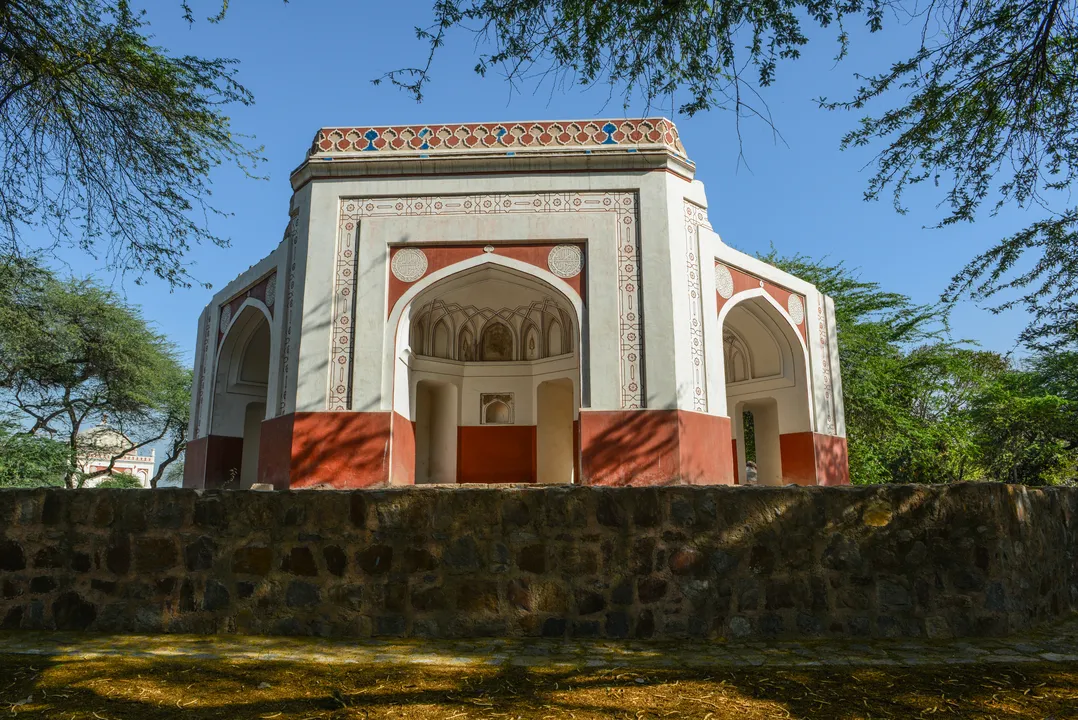
The 16th-century mausoleum is an architectural wonder, which was almost lost to neglect and decay,
has been renewed and preserved for generations to come through a restoration project that resulted
in its inclusion as part of a UNESCO World Heritage Site.
In the 1950s, the ownership of this complex was given to the Bharat Scouts & Guides to serve as a
camping ground.
This led, in 1989, to the construction of 150 structures.
Enclosure walls were demolished, disfiguring the landscape and the historic character.
Following twelve years of effort by the ASI and the Aga Khan Trust for Culture (AKTC), the ownership
was restored to the ASI in 2010, allowing systematic conservation and landscape restoration to be
undertaken by the AKTC.
The discovery of a large portion of enclosure walls, on the demolition of the 150 modern structures
that had been built over these, allowed the Mughal-era garden layout to be restored and, in turn,
ensure the integrity of a most significant 16th century ensemble.
After a careful documentation of the existing remains of original incised plaster work, restoration
work of the decayed decorative patterns was undertaken.
Completion of the restoring of the decorative plasterwork included decorative lime plastering along
with lime punning.
The restoration of the incised plasterworks was carried out by the master-craftsmen.
FAÇADE:
This structure was in a poor state of preservation with much of the western façade in a state of
collapse and the southern facade reconstructed by the ASI in 2002-4 to an inappropriate design thus
requiring to be demolished prior to an accurate reconstruction.
The northern façade was the best preserved.
During conservation works the inappropriate reconstruction carried out in previous conservation
attempts was carefully dismantled followed by reconstructing the half-domed profile on each of the
five bays on the southern façade and two bays of the eastern facade.
ROOF:
The kangura patterns on the parapet were reconstructed by replicating from the existing patterns and
finished in red polychromy and turquoise tiles.
The inappropriate past repairs carried out on the terrace like undulating multiple layers of cement
concrete were manually removed and replaced with lime concrete comprising lime mortar and brick
aggregate.
The rainwater spouts were missing, leading to rainwater percolating into the masonry and causing
deterioration of the wall plaster.
Hand chiselled sandstone waterspouts have been fixed on each of the four façades.
INTERIORS:
The main tomb chamber is set deep within the structure, and several feet below ground level.
It is surrounded by eight rooms that are symbolic of the hasht-bihisht plan that represent the eight
heavens described in the Quran.
Characteristic of the highest craft traditions of the period, the interiors have elaborate geometric
patterns adorning the walls and the ceiling.
The floral motifs symbolize the Islamic belief that since it is impossible to capture the face of
God, He is represented through natural forms.
During the restoration of the patterns in Mirza Muzaffar Hussain’s tomb, craftsmen made sure to use
tools and materials that were employed by the original builders.
Most of the 16th-century tombs in the complex cannot be identified.
However, this particular tomb can be distinguished as Mirza Muzaffar Hussain’s due to the
calligraphic inscription of his name on the walls.
After a careful documentation of the existing remains of original incised plaster work, restoration
work of the decayed decorative patterns was undertaken.
Completion of the restoring of the decorative plasterwork included decorative lime plastering along
with lime punning.
The restoration of the incised plasterworks was carried out by the master-craftsmen.
Enclosed Garden:
The lush setting of the tomb highlights it as a typical Mughal Garden tomb.
The char bagh layout is home to various trees that were favoured by the Mughals, such as neem and
citrus.
Conservation work here started after the demolition of more than 150 illegal structures in 1989,
which revealed a garden enclosure wall that was also reconstructed.
The entire stretch of the wall was also visible in early 20th century photographs taken from the roof
of Humayun’s Tomb.
To respect the Outstanding Universal Value of the Humayun’s Tomb World Heritage Site, which lies in
the complex being an ensemble of 16th century garden-tombs, it was agreed to reconstruct missing
portions of the enclosure wall.
Any trees found to be standing over the wall were allowed to remain, which occurred both in the
northern section and in the south-eastern corner.
The enclosure wall has been rebuilt in Delhi quartzite random rubble masonry in lime mortar by master
craftsmen using traditional building techniques.


.webp)


.webp)